
Yavnika Gulia
Project: Understanding why cervical cancer cells survive treatment to develop better treatments
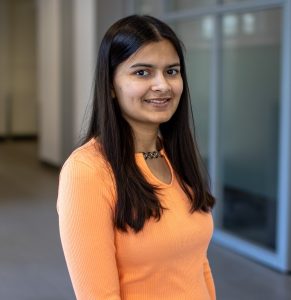
“One of the biggest surprises during my research was the complexity of the cellular pathways involved in cervical cancer drug resistance. It challenged me to step outside my comfort zone by reading research papers, asking questions and learning the biological mechanisms behind the drugs we used. This experience taught me that research is rarely straightforward, and that unexpected findings often lead to the most valuable learning opportunities.”
Summary: Cervical cancer remains one of the most common cancers affecting women in Canada, with rates increasing despite current vaccination and screening programs. These cancer cells often survive standard chemotherapy and radiation, leading to disease recurrence and spread, creating a critical need for more effective treatments. Dr. Gordon Chan’s lab has shown that blocking two cell-division safeguards — the proteins Wee1 and Myt1 — triggers mitotic catastrophe in tumour cells; however, the mechanism of resistance to Myt1 inhibitors remains unknown.
We hypothesize that cervical cancer cells rely on internal survival signals to evade Myt1-targeted treatment, even when it induces severe cell division errors. To investigate this, we are manipulating these signals to observe their effect on Myt1 treatment response and testing whether blocking them can re-sensitize resistant cells. Finally, we are comparing gene expression and protein activity between resistant cells and their non-resistant counterparts.
Understanding these resistance mechanisms will help us identify biomarkers to predict patient response, paving the way for more effective combination therapies that improve outcomes for women with cervical cancer.
Yavnika Gulia was supervised by Dr. Gordon Chan in the University of Alberta Department of Oncology, and her WCHRI summer studentship was funded by the Alberta Women’s Health Foundation. She is studying neuroscience in the Faculty of Science.
Read more about WCHRI’s training awards for students at all levels and generous grants for researchers. See the rest of the 2026 summer studentship recipients here.

